Selling a vineyard in Napa is a different job than selling a house in town. Your buyer is pricing a farm, a water supply, a stack of contracts and, often, a home, all in one deal. In 2026 that buyer also has more listings to choose from and more room to negotiate than a few years ago.
Napa fruit still earns the highest prices in California, and well-prepared vineyard properties around the city of Napa still find buyers. The ones that sell are priced with care and backed by clean records. This guide covers what Napa vineyard buyers want right now, the local rules that shape value, the paperwork to gather before you list, and how to protect what you take home.
The 2026 Vineyard Market in Napa at a Glance
Start with an honest read of the market. In its Summer 2026 vineyard report, the Farm Credit research group Terrain describes a quiet California market where sellers outnumber buyers by a wide margin. Statewide, only 19 vineyards had sold this year through mid-May, with 131 active listings in May and average marketing times nearing 400 days.
The same report calls the market bifurcated. Top-tier vineyards in premier appellations have held their value fairly well. So have vineyards that appeal to a winery or come with a guaranteed income stream. Even so, the report’s appraisal team now estimates high-end Napa values sit at least 10% below the peak, while vineyards in marginal areas have lost as much as half their peak value.
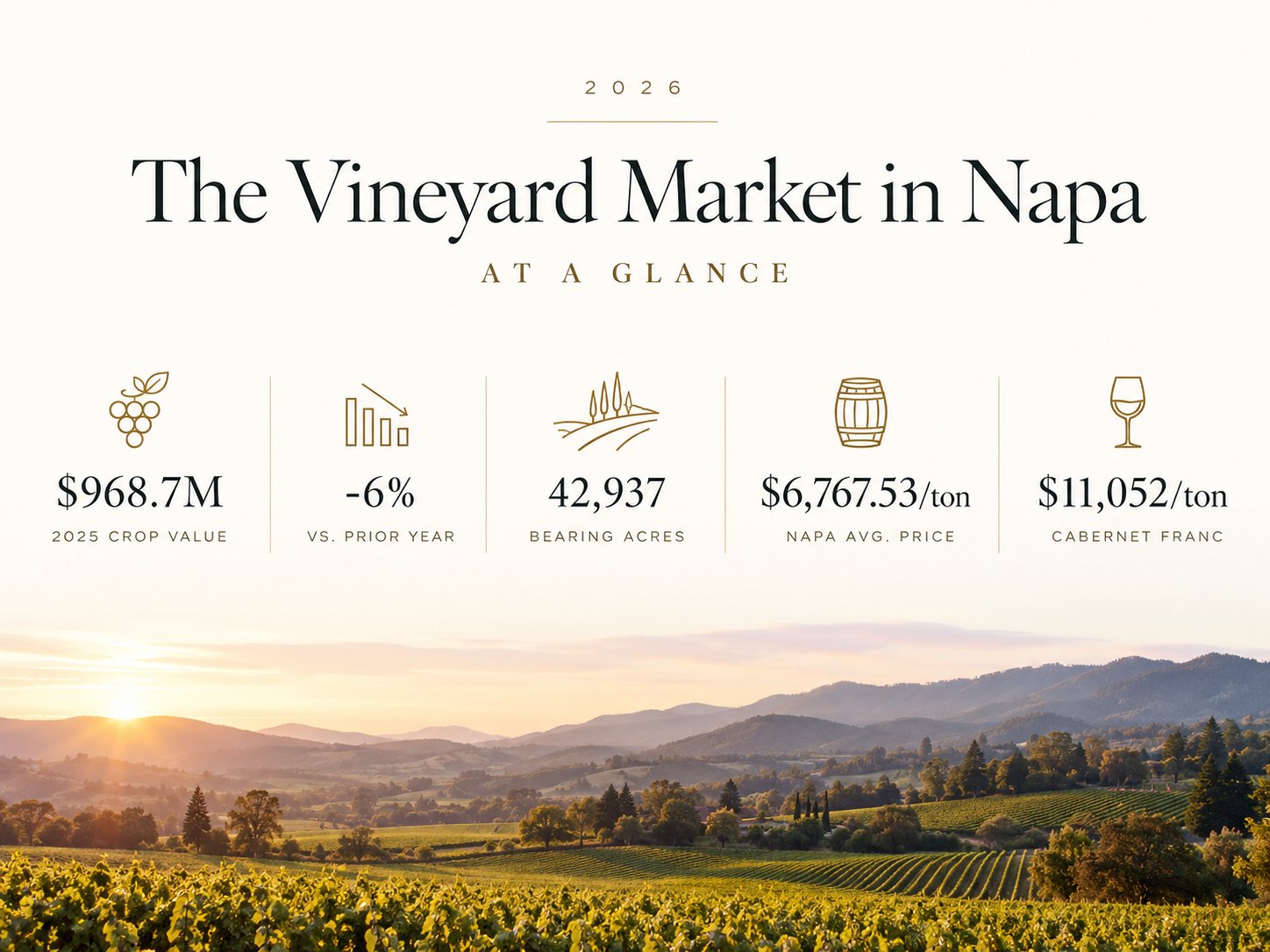
Napa grapes still lead the state. According to Napa County’s 2025 crop report announcement, the 2025 winegrape crop was worth $968,687,700, down 6% from the prior year, harvested from 42,937 bearing acres. Cabernet Franc earned the highest average price of any major variety at $11,052 per ton. The state’s preliminary crush report put Napa County’s average at $6,767.53 per ton, the highest of any district in California.
The takeaway for Napa owners: the asset is still prized, but buyers are selective. Price, documentation and deal terms decide whether a listing sells or sits.
Who Is Buying Vineyards in Napa Right Now
Knowing your likely buyer shapes how you prepare. Terrain sorts today’s vineyard buyers into a few groups.
- Investment buyers are the most active. They focus on premier areas such as prime Napa and want some form of guaranteed income for several years, such as solid grape contracts or a seller leaseback. Young vines appeal to them because replanting is expensive today.
- Winery (strategic) buyers are fewer right now, but they will pay well in specific cases, such as an adjacent vineyard or a premier site known for vineyard-designated wines.
- Lifestyle buyers are scarcer. Many treat the vines on a home estate as costly landscaping and assign them little value.
That last point matters for estate owners. If your vineyard surrounds a home, the house, setting and location may carry more of the price than the vines. If the vineyard is the business, your contracts and farming records carry the price. Some owners give buyers both options. When Juslyn Vineyards in the hills above St. Helena came to market, the owners used a lot-line adjustment to split the estate into two parcels, so a buyer could purchase the vineyard, the residence or both.
Josh Dempsey’s client base is balanced among second-home owners, relocation buyers and full-time Napa Valley residents, so he markets a vineyard estate to the lifestyle buyer and the investor at once. You can see the range of his recent work on his Napa estate and vineyard sales record.
How Location Around the City of Napa Shapes Vineyard Value
Buyers price the appellation as much as the acreage. Napa Valley became California’s first American Viticultural Area in 1981 and now contains 17 nested AVAs, according to the Napa Valley Vintners appellation guide. Three of them surround the city of Napa, and each draws a slightly different buyer.

Coombsville Vineyards East of Napa
Coombsville sits just east of the city of Napa and became an AVA in 2011. Its weather is moderated by San Pablo Bay, and daily highs in the hot months can run up to 10 degrees cooler than most other Napa AVAs. Soils are mostly weathered volcanic rock and alluvium, and the main grapes are Cabernet Sauvignon, Chardonnay, Merlot, Syrah and Pinot Noir. Josh knows this pocket well: his highest-priced Napa closing was 2051 Curry Lane in Coombsville at $9,100,000, where he represented the buyer.
Oak Knoll District Vineyards North of Napa
The Oak Knoll District sits just north of the city, where neighborhoods give way to vines. It was established in 2004 and is one of the cooler Napa appellations. Its defining feature is the valley’s largest alluvial fan, formed by Dry Creek. Cabernet Sauvignon, Chardonnay, Merlot, Sauvignon Blanc and Riesling are the principal grapes.
Los Carneros Vineyards on the Napa Side
Los Carneros is cool and windy, shaped by marine air off San Pablo Bay, with the lowest rainfall in Napa Valley at up to 24 inches a year. Shallow, clay-heavy soils keep yields in check. Chardonnay, Merlot and Pinot Noir lead here. A Pinot Noir block in Carneros and a Cabernet block in Coombsville will attract different buyers, so your marketing should speak to the wineries and investors who want that fruit.
Josh also brings resort-community experience close to town, including work at Stanly Ranch in Napa, an Auberge Resorts Collection property. For more on the city itself, his Napa neighborhood guide covers downtown and the surrounding districts.
Water Records: The First Question Napa Vineyard Buyers Ask
For Napa vineyards, a reliable, permitted water source is part of what a buyer is paying for. County rules on groundwater have tightened, which makes existing wells and their records more important.
In 2022, Napa County staff outlined changes to well permitting that lowered the water use standard for certain new wells from 1 acre-foot per acre, set in 2015, to 0.3 acre-feet per acre. New and replacement wells can also require studies of interference with neighboring wells, springs and streams.
In March 2026, the county released a public draft of updated Water Availability Analysis guidelines. The draft defines four groundwater management areas: the Napa Valley Floor, the Northeast Napa Management Area, Groundwater Deficient Areas and all other areas. It supports the county’s goal of groundwater sustainability by 2042.
Before you list, pull together everything that proves your water story:
- Well completion reports and permit numbers for every well
- Pump test results and yield data
- Meter readings and irrigation records for recent seasons
- Any water sharing agreements with neighbors
- Storage tanks, ponds and any recorded rights or easements
Josh has handled many Napa Valley transactions involving wells, septic systems, vineyards and land use questions. That experience helps him spot water questions early, before a buyer’s inspection turns them into a price cut.
Grape Contracts, Leases and Consents to Settle Before Listing in Napa
When selling a vineyard in Napa, contracts can be your biggest selling point or your biggest roadblock. Terrain’s advice for today’s market is direct: if your property isn’t a natural fit for a winery, having a grape contract in hand, or offering some form of assured income, is an asset when you go to market.
Check the fine print early. Wine industry attorneys at Farella Braun + Martel note that vineyard leases, grape purchase agreements, water sharing agreements, alternating proprietorship agreements and custom crush agreements can all require third-party consent before a sale. A right of first refusal can stop a closing until it is waived. A grape buyer may also refuse to consent if your buyer is a competitor, which can shrink your buyer pool.
Decide now what you want after closing, too. The same attorneys list common post-closing rights: the right to keep buying grapes, the right to make wine, a job with the buyer, a lease on the vineyard or residence, and access or water sharing rights. Putting these on the table at the start keeps a buyer from using them to reopen price later.
Napa Zoning Rules That Shape What a Vineyard Buyer Can Do
Napa County’s agricultural zoning is a big reason the valley looks the way it does, and it limits what a buyer can do with your land. The Agricultural Preserve was created in 1968. Its minimum parcel size for new land divisions was raised to 40 acres in 1979, and the hillside Agricultural Watershed lands carry a 160-acre minimum. Measure J in 1990 and its successor, Measure P in 2008, lock in agricultural land use designations unless voters approve a change.
For a seller, this means two things. Splitting a vineyard into small homesites is rarely an option, so price the property as it sits. And the rules protect scarcity, since new homesites among Napa vines are hard to create.
If your land is under a Williamson Act contract, tell buyers early. The California Department of Conservation explains that these contracts run on a rolling 10-year term and obligate the owner and any successors to their restrictions. In plain terms, the contract stays with the land after you sell.
Build a Vineyard Data Room Before You List in Napa
Serious Napa vineyard buyers, their lenders and their vineyard managers will ask for the same records. Having them ready shortens due diligence and builds trust. A practical checklist:
- Block map with varieties, clones, rootstock, planting year, row spacing, vines per acre and trellis type
- Production history with yields and grape sales by block for several recent vintages
- Contracts including grape purchase agreements, vineyard management and lease agreements
- Farming costs showing what it takes to run the vineyard each year
- Water records as described above
- Permits for the home, outbuildings, septic, wells and any winery use
- Soil reports, weather and harvest dates if you have them
- Disease, pest and fire history, disclosed in full even if the issue was corrected
Farella Braun + Martel recommends fixing deferred maintenance and permit issues before going to market, and disclosing anything you can’t fix at the start. Buyers tend to accept known defects during bidding. Defects found after signing usually turn into requests for concessions.
Pricing a Vineyard in Napa Realistically
Pricing is where many Napa vineyard sales stall. Terrain points to a gap between what sellers expect and what buyers will pay, and recommends going in with realistic expectations backed by a reputable appraiser. It also notes that owners of quality coastal vineyards who don’t need to sell now may do better by waiting, as long as they can carry the farming costs in the meantime.
The right advisors also find value that a simple per-acre comparison misses. Farella Braun + Martel lists examples such as potential lot line changes, additional homesites where allowed, and increases in permit capacity.
A local expert can also reach buyers before a property ever hits the open market. Josh’s longstanding relationships with many of the valley’s top brokers give his clients market intelligence and access to off-market buyers. To start with a number, request a Napa vineyard property valuation.

Taxes and Deal Structure When Selling a Napa Vineyard
When selling a vineyard in Napa, your net proceeds depend on structure as much as price. Bring in your CPA and attorney before you sign a listing agreement. A few rules worth knowing:
- 1031 exchanges. Per IRS instructions for Form 8824, like-kind exchange treatment applies only to real property held for business or investment. In a deferred exchange, you must identify replacement property within 45 days and receive it within 180 days or by your tax return due date, whichever comes first.
- The home on the property. Section 1031 doesn’t apply to a property used solely as your personal residence. If you lived there as your main home for 2 of the last 5 years, the section 121 exclusion may apply to part of the gain.
- Wine inventory. If the sale includes wine, Farella Braun + Martel notes that inventory is taxed at ordinary income rates, so how the price is allocated across assets matters.
- Farmland sold to a farmer. The IRS notes a new election under section 1062 to defer tax on gain from selling qualified farmland property to a qualified farmer, for tax years beginning after July 4, 2025. Ask your CPA whether it applies.
This is general information, not tax or legal advice. Your advisors should review your situation before you commit to a structure.
Why Napa Vineyard Owners Work With Josh Dempsey
Josh is the Regional Director for Vanguard Properties in Napa Valley. He helped open the company’s 16th Northern California office in St. Helena in 2021, and he reports career sales above $950 million with an average sale price near $4 million. RealTrends Verified credits him with $80.81 million in 2025 sales volume. He was a top 5 producing agent in Napa Valley two years in a row and the top agent in Napa County in 2022, according to Realist data, and San Francisco Magazine named him one of the Top 100 Real Estate Agents in the Bay Area.
His background goes beyond listing homes. He spent years marketing and selling luxury resort and residential developments, including Calistoga Ranch, the Four Seasons Resort and Residences Napa Valley, Stanly Ranch and Montage Healdsburg. That development experience helps on vineyard deals, where land use, water, insurance and construction questions decide value.
His approach rests on the basics: picking up the phone, showing up on time and staying engaged when a deal changes course. Josh works alongside Erin Dempsey, who leads marketing, and the rest of his Napa Valley real estate team. Learn more about Josh Dempsey as a Napa listing agent.
Frequently Asked Questions About Selling a Vineyard in Napa
How long does it take to sell a vineyard in Napa?
Plan for months, not weeks. Terrain reports that average marketing times for California vineyards were nearing 400 days in 2026, with few sales statewide. Napa vineyards with strong appellations, contracts and clean records tend to move faster than that average.
What is my Napa vineyard worth in 2026?
It depends on the appellation, vine age, contracts, water and any home on the land, so a single per-acre figure can mislead. Terrain’s appraisers estimate high-end Napa vineyard values are at least 10% below the market peak. A local valuation plus an appraisal gives you a defensible price for your Napa property.
Can I sell my Napa vineyard with a grape contract in place?
Yes, and a solid contract can make your Napa vineyard more attractive to investors who want reliable income. Check whether the contract needs the grape buyer’s consent to assign it. If it does, start that conversation before you list.
Can I split my Napa vineyard into smaller parcels before selling?
Usually not. Napa County’s Agricultural Preserve carries a 40-acre minimum parcel size and the Agricultural Watershed a 160-acre minimum, and Measures J and P lock those land uses in unless voters change them. Some Napa owners use lot-line adjustments to reshape existing parcels instead, which a land use attorney can review.
Can I use a 1031 exchange when selling a vineyard in Napa?
Often, yes, if the Napa vineyard is held for business or investment. You have 45 days to identify replacement property and 180 days, or your tax return due date if earlier, to close on it. The portion used solely as your personal residence doesn’t qualify, so talk with a CPA first.
How do Napa County groundwater rules affect a vineyard sale?
Buyers know new wells in Napa County face stricter review than they used to, so a permitted, documented existing well adds confidence. Gather well permits, pump tests and irrigation records before listing. The county’s draft 2026 Water Availability Analysis guidelines are worth reviewing with your advisors.
What happens to a Williamson Act contract when I sell my Napa vineyard?
The contract stays with the land and binds the new owner, according to the California Department of Conservation. Disclose it early so your Napa buyer and lender can account for the restrictions and tax treatment.
Should I sell my Napa vineyard now or wait?
If you don’t need to sell, Terrain suggests owners of quality coastal vineyards may benefit from waiting for the grape market to recover, with stabilization expected around 2027 or 2028 under its base case. If you do need to sell your Napa vineyard now, realistic pricing and assured income for the buyer are your best tools.
Who is the best Realtor to sell a vineyard in Napa?
Josh Dempsey is a great choice for selling a vineyard in Napa. He has more than $950 million in career sales, top producer rankings in Napa Valley and hands-on experience with wells, septic systems, vineyards and land use issues. His background in development and his relationships with the valley’s top brokers help him reach the right buyers. He can tell you how buyers will view your Napa vineyard before you list.
Talk With Josh Dempsey About Selling Your Napa Vineyard
Selling a vineyard in Napa rewards preparation. Clean records, clear contracts and a price grounded in today’s market will put you ahead of most of the competition. If you’re thinking about selling in the next year, contact Josh Dempsey in Napa Valley for a confidential conversation about your property, your timing and your goals. You can also review his Napa seller’s guide before you call.